
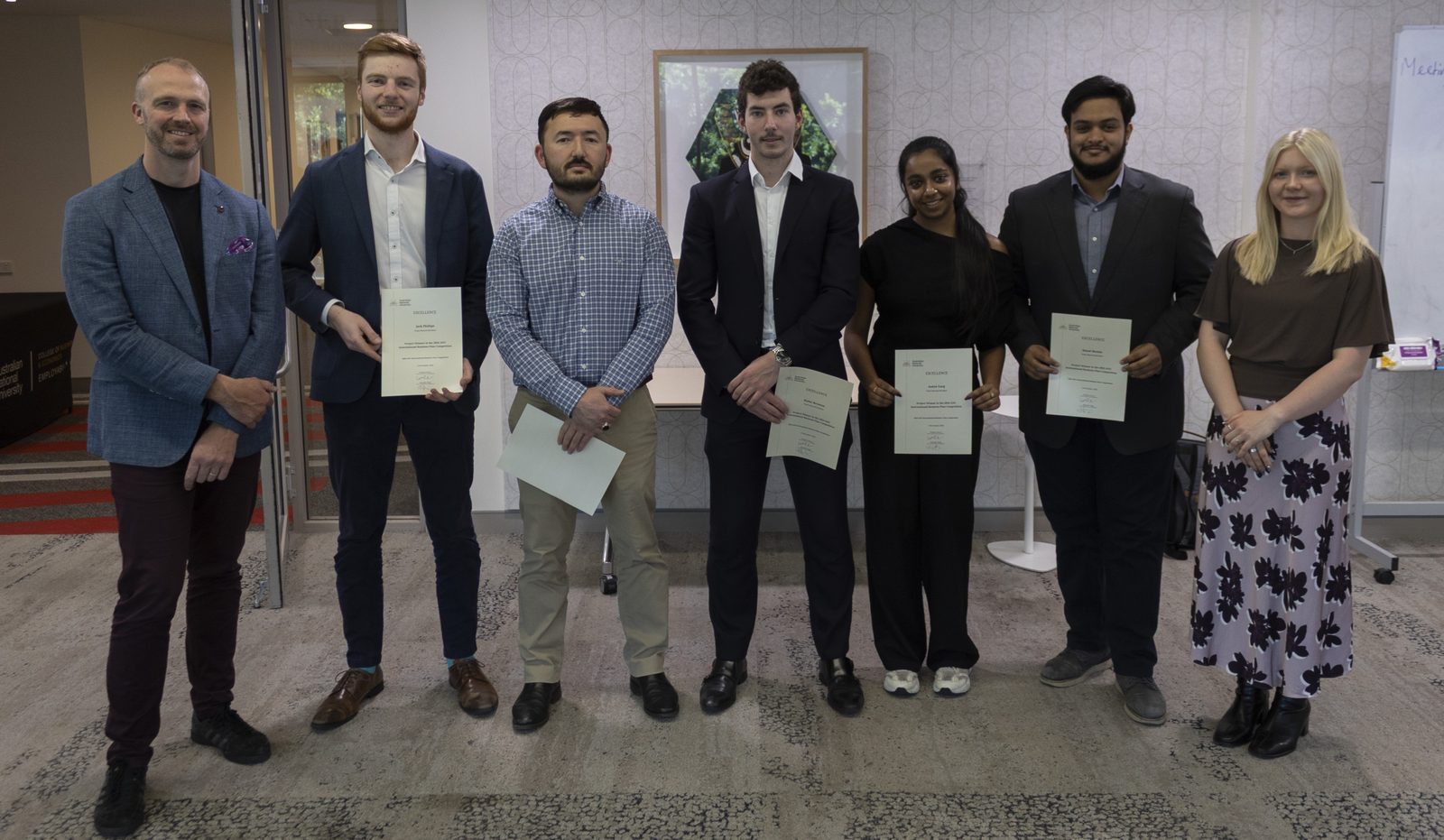
Congratulations to Aanya Garg, Ikmal Momin, Jack Phillips, Kiefer Brennan and Mumtaz Jafari of Beyond Borders Consulting, the winning team in this year’s ANU International Business Plan Competition.
Their brief was to work out how EPC Renewables could take its Australian engineering, solar PV, battery storage, microgrid and digital monitoring capability into the Pacific. The team compared Fiji, Samoa and Papua New Guinea on logistics, diesel dependence, Australian Government support, security and institutional stability, and identified Fiji as the strongest first market and a potential regional hub for future Pacific growth.
A central finding was that our advantage does not come from equipment price. The team pointed instead to Australian engineering standards, end-to-end EPC delivery, integrated solar and battery systems, ongoing monitoring through our Insight monitoring platform, financing pathways and lifecycle support. They also found that international expansion depends on local relationships, technical capability, disciplined market selection and a clear understanding of logistics, regulation and customers’ capital constraints.
These findings line up closely with how EPC Renewables is developing today. Fiji offers the chance to bring Australian engineering to customers who want to cut diesel use, improve energy resilience and lower long-term operating costs, while building local delivery capability and partnerships. Over time, the same model can support growth into other Pacific markets.
For EPC Renewables, the value goes beyond the recommendations. The program gave us an independent view of the business, challenged some of our assumptions, and brought fresh thinking on how engineering, finance, technology and local capability can combine for sustainable international growth.
“Meaningful engagement between industry and education becomes particularly valuable when students are working on real commercial problems,” said Jay Robinson, Chief Commercial Officer of EPC Renewables. “International energy development requires engineering, finance, culture, logistics and relationships to work together, and programs like this give students the opportunity to understand those challenges while giving businesses like EPC Renewables access to new perspectives and ideas.”
“The energy transition will not be delivered by continually applying the same thinking to new problems,” he said. “We need to support creativity, different perspectives and people who are prepared to challenge what is considered normal. Programs such as the International Business Plan Competition create an environment where new ideas can be tested, challenged and improved, and that type of thinking can genuinely help change the shape of the energy industry.”
Our thanks to Alexander Tietge and the ANU College of Business and Economics for including us, and to every team that took on our brief. We look forward to continuing our engagement with the program in 2027.